
Annual Science Day
Please allow social and marketing cookies to show embedded content.
Friday, 20 March 2026
Robinson College, Crausaz Wordsworth Building, Adams Road, Cambridge
The LCLU Science Day 2026 brought together research related to Life in the Universe from across the University of Cambridge. The programme will include talks, keynote lectures from LCLU members, poster presentations, and time for discussion and networking. Lunch, refreshments, and a drinks reception will be provided.
 |  |  |
For any questions please contact the organisers admin@lclu.cam.ac.uk
Keynote Talks
As we move towards an epoch of rocky exoplanet discovery, composition is key to assessing potential habitability. The talk discuss how the bulk composition of planets influences their habitability, as well as the potential for late delivery to provide material crucial to prebiotic pathways. Observations of planetary material in the atmospheres of white dwarfs can inform us about planetary composition and geology. This talk will probe the link between host star and planet compositions, as well as the journey of volatiles, crucial for habitability, from planet forming discs into rocky planets.
Ribosomal peptide synthesis (RPS) is orchestrated through the aminoacylation of RNAs by aminoacyl-tRNA synthetase enzymes that are produced by RPS. This causal paradox, which was established prior to the evolution of life’s last universal common ancestor, obscures the origins of protein biosynthesis. To break this paradox, we set out to build a deterministic model of the minimum reactivity required to initiate peptide biosynthesis. The chemical unity and antiquity of life’s central metabolites provide compelling evidence that a simple set of chemical reactions predicated the appearance of life on Earth,1-2 and we reasoned that rediscovering such a reaction network, and the rules that control it, would be the key to uncovering the origins of peptide biosynthesis. In this talk recent advances that suggest life’s nucleotides,1,3 peptides, 3-7 and cofactors8 are predisposed structures will be presented. These results indicate that (biological) thioester activation can direct RNA to intercept peptide synthesis,9 which is an essential step towards establishing life’s central dogma.
Reflections on the day
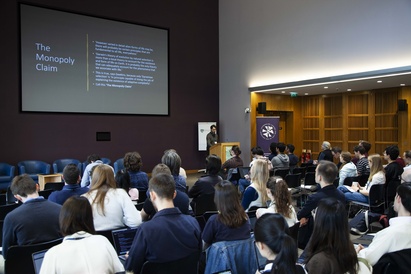
On Friday 20th March, researchers from across multiple departments gathered at Robinson College for the LCLU’s Annual Science Day 2026. The presenters were mainly early career researchers working in fields ranging from astronomy and earth sciences to chemistry, physics, and philosophy. The event celebrated the multidisciplinary research carried out on Life in the Universe themes across the university, featuring keynote talks from Dr Amy Bonsor on exoplanet composition and habitability, and Prof Matthew Powner on the origins of life’s peptides.
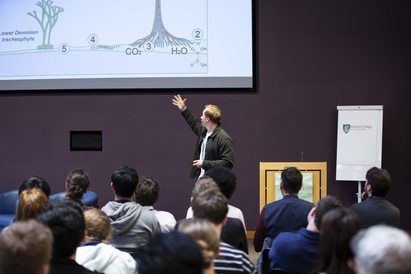
The day featured four themed sessions exploring fundamental questions about life in the universe. The first session, Hidden Oceans, launched us into the search for life beyond Earth, examining atmospheric composition in exoplanets such as K2-18 b and exploring how magma oceans and planetary interiors shape observable signatures. This set the stage for discussions on how we detect and interpret potential biosignatures in distant worlds.
Next, The Rocky History of Planets Cracked Open turned to planetary formation and evolution. Talks explored the billion-year histories of exoplanets, evidence for early heavy bombardment in the Solar System, the role of highly siderophile elements in understanding Earth’s formation, and the long-term atmospheric consequences of giant impacts. Together, these contributions highlighted how violent planetary histories may set the stage for habitability.
Following the second keynote, the session How Chemistry Became Biology examined the transition from prebiotic chemistry to living systems. Speakers presented work on RNA ligation, self-replicating molecular systems, the role of chirality and spin selectivity, and the stability of key prebiotic molecules such as hydrogen cyanide. These talks offered complementary perspectives on how life might emerge from simple chemical beginnings.
Finally, Conditions for Life on Earth and Beyond broadened the lens to planetary-scale processes and conceptual frameworks. Contributions ranged from the role of magnetite in establishing molecular asymmetry to large-scale geochemical cycles and biosphere–planet interactions. The session also included a talk on ecological modelling of potential biospheres on Hycean worlds and concluded with a philosophical perspective on chance and contingency at life’s origins.
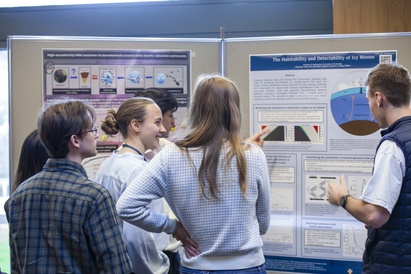
The day featured collaborative breaks where attendees continued discussions sparked by the talks and engaged with poster presentations. Robinson College provided an excellent setting for these exchanges throughout the day. Awards were presented to Jules Macome for best talk and ‘The Habitability of Titan’ for best poster presented by MPhil Students; Imaan Rahim, Chris Meadows, Helena Nicolaides, Lucca Castlevetro and Charlotte Crick, Institute of Astronomy. The annual science day was an opportunity to showcase ongoing research and exchange ideas across various disciplines capturing the interdisciplinary spirit at the heart of the LCLU.
Review by Jules Macome, Lucia Trevisan, Gregory Cooke, Lukas Rossmanith