
Research Themes
Research within the Centre aims to develop a deeper understanding of life, its emergence, and its distribution in the Universe by addressing four questions:
- What are the chemical pathways which led to the origins of life that are compatible with benign conditions for life in different planetary environments?
- How do we characterise the environments on Earth and other planets that could act as the cradle of prebiotic chemistry and life?
- What observational facilities and methods will allow investigation of bodies beyond the Solar System, the remote sensing of their atmospheres and the search for signatures of geological and biological evolution?
- How can philosophical and mathematical concepts refine our understanding of what we mean by life, leading to new interdisciplinary collaborations and modes of scientific enquiry?
To achieve these objectives, research activities across the Centre are designed to facilitate continuous communication and interaction among the sciences and the arts and humanities as illustrated below.
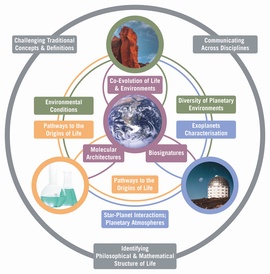
Flow of information and research activities across the Centre: Robust understanding of life in the Universe can only be achieved through communication and iteration among several sciences and the arts and humanities.
Core Research Programmes
The Centre's core research programme consists of four themes:
The transition from prebiotic chemistry to living systems occurred within a narrow window in Earth’s early history. One approach to unravelling life’s chemical origins involves exploring the many possible pathways from simple molecules synthesised in ancient environments, to self-replicating systems leading to the last universal common ancestor (LUCA; Sutherland 2016). As a starting point, these pathways may be differentiated by considering: 'complexity’, which can be loosely categorised by the size of the chemical molecules involved, and 'aliveness', or the ability of a multi-molecular system to reproduce and/or adapt to evolving environmental conditions. This research objective will prioritise continuous collaboration between physical scientists and arts and humanities scholars to recognise the onset of ‘living’ systems.
Chemical pathways along the transition from prebiotic chemistry to life: Chemical pathways connecting the inanimate state to the animate can only be confidently unravelled with detailed knowledge of planetary environments, and fresh analysis of concepts such as ‘aliveness’, ‘complexity’ and ‘life’.
Traces of prebiotic chemistry from Earth’s young surface have been largely erased by plate tectonics. Nevertheless, we now understand that the Earth has always operated as a single complex system driven by the interactions between energy, matter, and organisms. We can therefore be certain that prebiotic chemical pathways would have co-evolved with environmental conditions through Earth’s early history. In that respect, ongoing Mars exploration is a milestone event for obtaining insights on Earth's early history.
This research objective will focus on understanding: the diversity of prebiotic planetary environments, including their connections to planetary interiors, to global climate, and to each other; the dynamics of planetary environments, and how a planet’s physical and chemical evolution shapes local prebiotic environments and their global distribution with time; and how biological processes regulate planetary environments to maintain their habitability and lead to their remote detectability.
Generalised evolution of a rocky planetary body: Boundary conditions such as size, proximity to host star, composition, orbital/dynamical environment during planetary formation and evolution influence planetary environments, available chemical pathways, and the capacity of any planet, including our own, to support life.
The discovery of exoplanets, placing our Solar System as one amongst countless planetary systems, opened a Pandora’s box of questions about the uniqueness of the Solar System and the prospect of life on extrasolar worlds. A prerequisite to explore the origin of life in the Universe is establishing a coherent model to test the habitability of exoplanets across their vast diversity of system configurations, ages, compositions, and climates. This is especially true for temperate planets orbiting close to small and cooler stars (M dwarfs), which are ubiquitous but experience very different surface irradiation. For this purpose we need to gain deeper insights about the internal structure, atmosphere and geochemical conditions on these exoplanets.
Our work focuses on: the development and implementation of ground-based high-precision Doppler surveys to discover nearby habitable-zone planets conducive for life, high-precision atmospheric remote sensing of habitable-zone exoplanets, the development of dedicated space missions to enable detections of biosignatures in Earth-like exoplanets, and the development of robust modeling and theoretical frameworks to relate the atmospheric and surface properties observable on exoplanet systems at various stages with the underlying geochemical and biotic/prebiotic processes.
Few topics have been more central down the centuries of human thought than the nature of life. This discourse has yielded a diversity of insights, which offer a rich resource for academic investigation and debate among diverse intellectual traditions. This diversity is a real advantage as we face the challenge of working from the one example of life we are familiar with on Earth to the existence of life elsewhere. The Centre will address these traditions of thought over the coming decade, with the goal of creating a forum for research on the nature and emergence of life from the viewpoint of the arts and humanities. The aim is to provoke new and creative fields of interdisciplinary research with the sciences – it will challenge scientists to examine the models and assumptions of traditional scientific endeavour.